
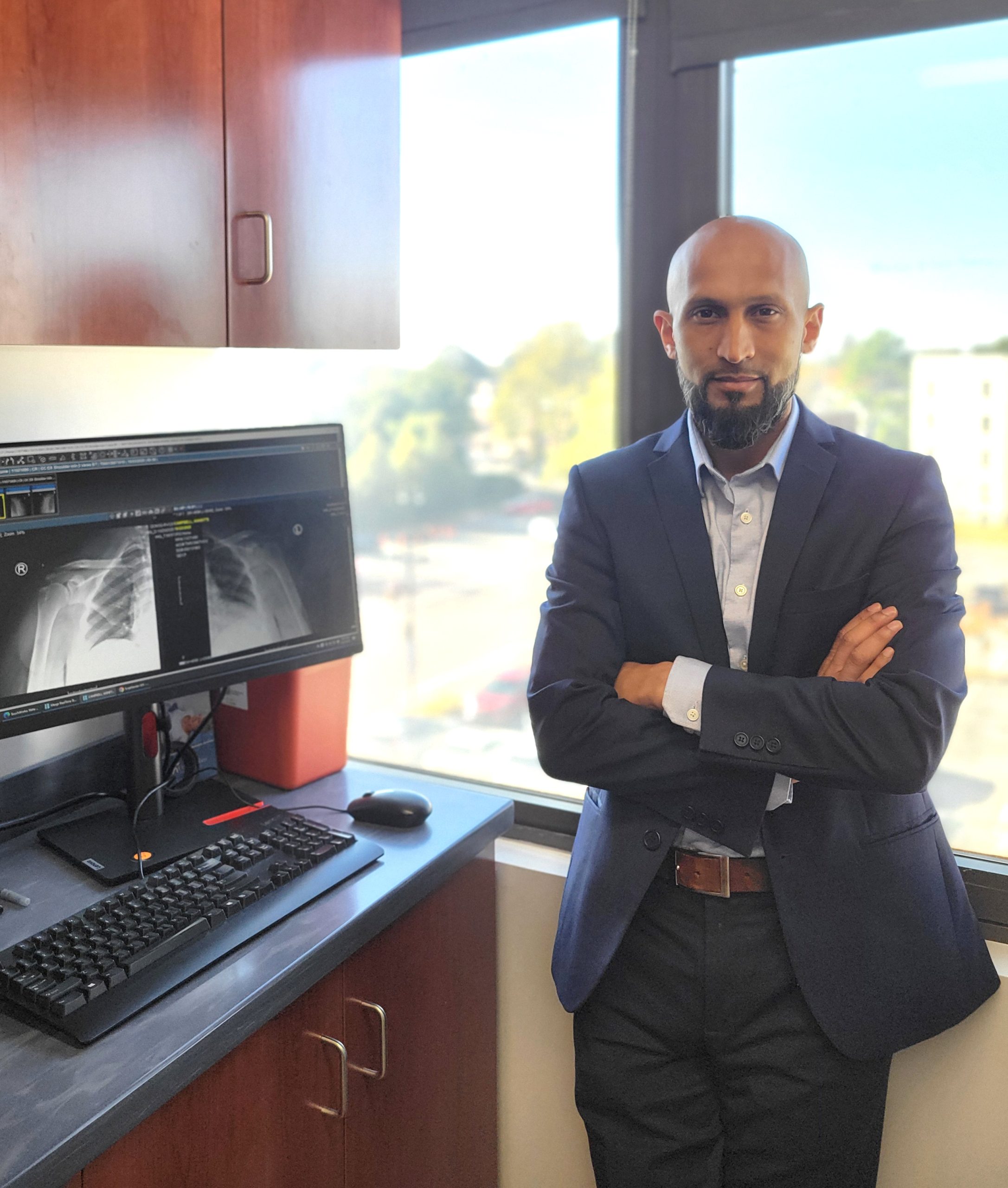
A Personal Note from Dr. Manaqib
Avascular Necrosis (AVN) is a topic near and dear to my heart. It is a diagnosis that presents a challenge for orthopaedic surgeons everywhere to address, and it is a diagnosis that can be a life altering finding for patients of all ages. This condition is a problem I have faced for years in my clinical practice and professional career; but then suddenly faced in my own personal life as well. In November 2022 I was diagnosed with AVN of the femoral head of both hips. Without warning, I quickly declined from being an active basketball, soccer and ultimate frisbee player in the summer and prolific skier in the winter, to being unable to bear weight on my legs within 1 week without any trauma or injury.
Although the cause of AVN is specific to each patient and not always evident; for me, the cause seemed apparent- I had undergone surgery for another issue in February 2022 and following that surgery, I underwent a routine course of corticosteroid medications for swelling and inflammation. Unaware of any underlying issues, I recovered quickly and resumed my normal routine.
One morning, sprinting down the basketball court, upon taking a hard step I felt sudden pain in the right hip and was unable to continue. The pain was persistent and did not resolve with conservative treatment. A subsequent MRI demonstrated AVN involving both of my hips. I subsequently began my journey to seek treatment as a patient, but with the advantage of access to various colleagues who are the top orthopaedic specialists around the country. After the necessary deliberation, I underwent various different treatments, both surgical and nonsurgical to try and salvage my hips.
The process was challenging and unfortunately the results were disappointing. This is the experience for many patients, not just myself. And I understand more than ever – We can do better. We should do better. We must do better.
That is my objective.
What is Avascular Necrosis (AVN)?
Avascular Necrosis or Osteonecrosis is a condition involving the death and destruction of bone and bone cells as a result of devascularization or loss of blood flow. Bone is a living tissue which is continuously turning over and remodeling in order to maintain its solid structure despite significant continuous microtrauma and both acute and cyclic wear over time from normal and increased activity. Bone relies on certain specialized cells known as osteoblasts and osteoclasts, which build and absorb bone, respectively. Much like, every living tissue, these cells require energy to function and this comes through oxygen transfer via red blood cells.
When the flow of red blood cells to the bone is disrupted for a period of time, the oxygen delivery to bone will cease and bone in the region will undergo an ‘infarct’. This term may be familiar as this phenomenon is akin to the loss of the blood flow to the heart, known as a ‘myocardial infarction’ or heart attack. In a heart attack, the muscular tissue of the heart dies as a result of the loss of blood flow. Similarly, in a bony infarct the cells that turn over bone die as a result of the loss of blood flow.
What Causes AVN?
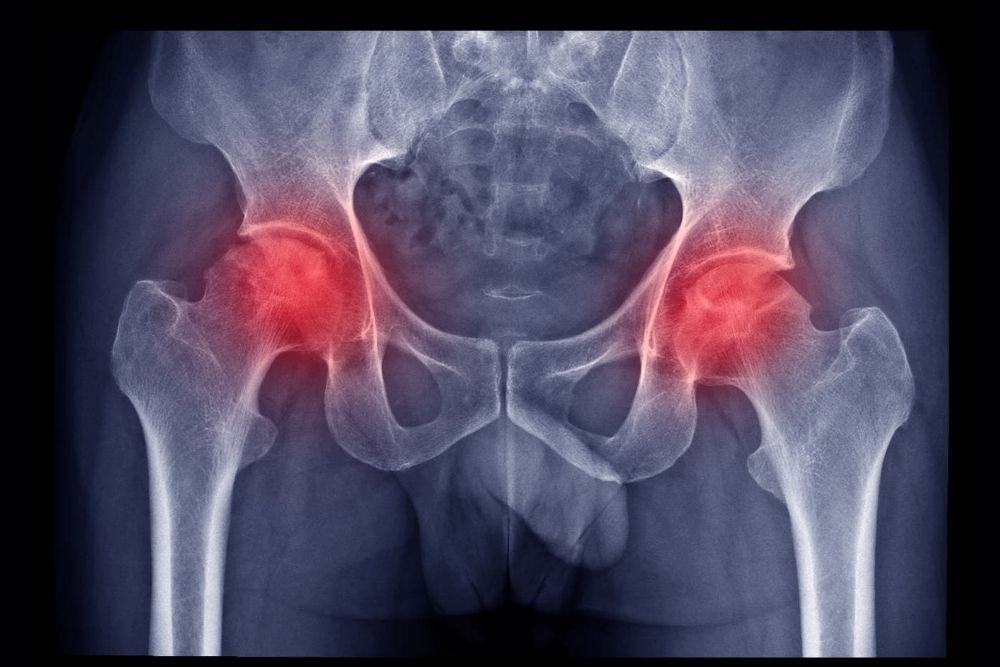
AVN can have various causes, and sometimes the exact etiology can be difficult to determine. Corticosteroid medications, alcohol, trauma, metabolic conditions, genetic disorders, vascular abnormalities, in addition to other diagnoses, may cause it.
- Prolonged corticosteroid (prednisone, cortisone) usage
- Alcohol
- Femoral neck fracture
- Hip Dislocation
- Gaucher’s disease
- Sickle Cell Anemia
- Bisphosphonate medications
- Hematologic conditions
- Radiation
- Chemotherapy
- Legg-Calve-Perthes (children)
- Cancer
- Diabetes
- Smoking
The Natural History & Progression of AVN
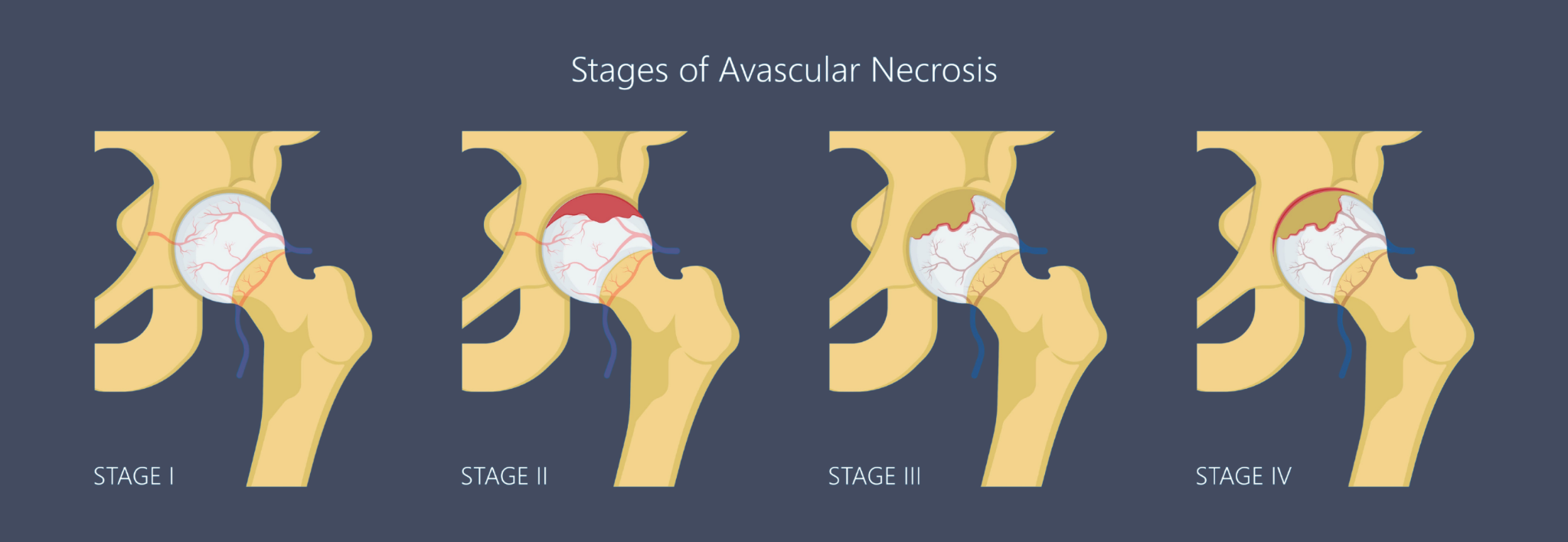
Once the bloodflow is disrupted, the now devascularized bone is no longer able to remodel quickly, and succumbs to the microtrauma of everyday activity and forms an area of dead or necrotic bone. Often times this occurs in the subchondral region of a joint right under the layer of cartilage that allows for smooth joint movement. Lacking the quality and structural properties of living functioning bone, over a period of time, often times less than two years, the geometry of the bone begins to change with progressive collapse from the weight of the human body and cyclic loading from daily life. The result especially in the case of the femoral head, is a square peg in a round hole. This incongruent new anatomy, ultimately results in abnormal pressure across cartilage within a joint, leading to its degradation and ultimately an arthritic joint.
How do you treat AVN?
There are numerous treatment approaches for AVN, both surgical and nonsurgical. These options may be presented to you based on specific considerations related to the your characteristics and findings on imaging related to distribution, location and extent of the pathology. The treatment options can have varying levels of success and a thorough discussion with the orthopaedic surgeon is required to determine the best individual path forward.
- RICE
- Physical therapy
- Limited weight bearing
- Bisphosphonates
- Lovenox
- Corticosteroid injections
- Viscosupplementation
- Hyberbaric Oxygen Therapy
- Platelet Rich Plasma
- Core decompression
- Free vascularized fibula grafting
- Arthroplasty
Get Specialized AVN Care